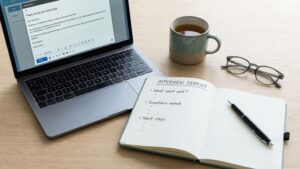
Things to do after your interview
10/10/2017
After your job interview Don't put your feet up just yet! The interview might be…
People learn in different ways, and preferences are real. The helpful bit is not putting myself in a box. In practice, mixing methods like testing myself, spacing my revision, and practising the skill tends to work best for everyone. This guide helps me spot what I prefer, then build a simple plan that actually sticks.
Editor note: replace the hero image with a locally uploaded image for best speed. Suggested size 2240 by 1260. No text on the image.
This is not a label for life. It is just a quick way to notice what helps me start and stay focused.
I can prefer one style, but I do not rely on it alone. A mix usually wins.
Pick two methods and use them together. That is usually enough.
I test myself instead of only reading. Questions force my brain to work.
Quick ways I test myself:
• Write 5 questions from the lesson, then answer them without looking
• Cover my notes and explain the topic out loud in 60 seconds
• Do 3 practice tasks, then check what I missed
I come back to the topic over time, in short sessions, instead of one long push.
A simple spacing plan:
Day 1: learn and test myself
Day 3: short review and test myself again
Day 7: quick recap and one practice task
Day 14: final check, focus on weak spots
I mix two small topics in one session. It can feel harder, but it helps learning stick.
Example session:
10 minutes: Topic A summary and 3 questions
10 minutes: Topic B worked example
10 minutes: Topic A practice task
I remove friction so starting does not feel like a big event.
If flashcards help, I can turn notes into questions and practise them in short bursts.
Pick one. I can always adjust next week.
This keeps me moving when I feel overwhelmed.
1) Open the lesson and pick one small task
2) 10 minutes: read or watch
3) 10 minutes: test myself with questions
4) 10 minutes: practise one task
5) Write one note: what I will do next session
If I am studying for work, I keep proof of what I can do. It helps with CVs and interviews.
This box is editable. I can paste my course goals and plan my sessions here.
If you want structured learning and practical skills you can apply straight away, our online courses are built for real life schedules.
This article is general study guidance. If you need learning support, please reach out to your tutor or Course Advisor.